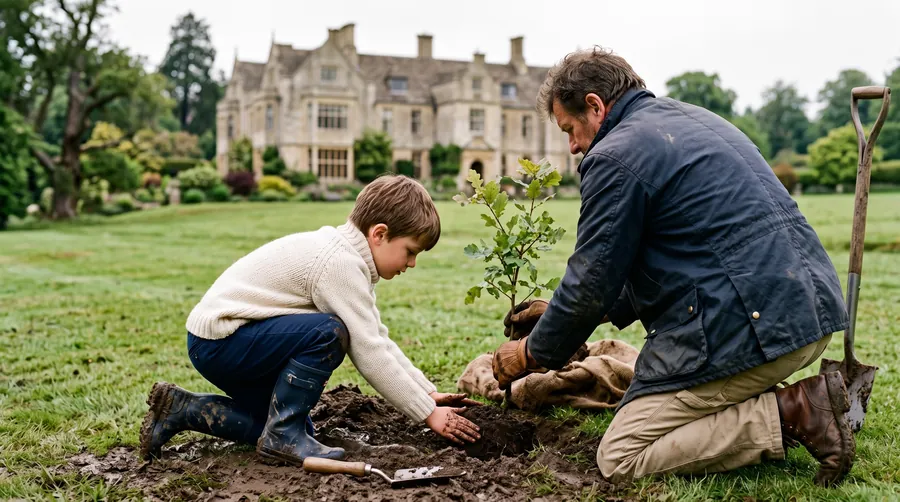
Every wealthy parent has the same fear and expresses it the same way: I don't want them to grow up spoiled. The fear is reasonable. The research on children of affluence, much of it from American universities that have studied their own alumni's families for decades, finds higher rates of anxiety, substance use and a particular kind of hollowness among children of the very rich than among children of the middle class. It also finds that the families who avoid it share habits, and the habits are teachable.
1. Effort before reward, visibly
Children learn what they see. A child who sees a parent leave for work at seven, come home tired and talk about a problem they solved learns that money is the result of effort. A child who sees money appear from a family office learns that money appears. The families who do this well talk about work at dinner, take children to the office or the factory or the vineyard, and let them see a bad quarter as well as a good one. Inherited wealth is harder: the effort happened two generations ago. Those families substitute their own work, philanthropy done seriously, a business started, a house restored, so that the children see somebody in the family sweat.
2. No, often enough that yes means something
The child who is never refused cannot value anything, because value is the experience of wanting something and not yet having it. Grounded families say no to the second pony, the phone at nine, the party in Ibiza at sixteen, and they say it without a lecture. They also make the child wait: a birthday present at the birthday, not in the shop; a new racket when the old one is worn, not when the friend has one. Waiting is a muscle and the rich have to build it artificially.
3. Chores, real ones, unpaid
A household with staff is the hardest place to teach children that a house is work. The families who manage it draw a line: the staff run the house, but the children make their beds, clear their plates, walk the dog and, from twelve, cook one dinner a week. Not for money; for membership. Paid work is separate and comes at fifteen: a summer job for a stranger, at a stranger's wage, with a boss who did not know the parents. Our list of fifty experiences before eighteen has it at number fourteen.
4. Money talked about, not hidden
Children know. They know by six that their house is bigger, by ten that their holidays are different, by fourteen roughly what the family is worth, from the internet if not from you. Silence teaches that money is shameful or dangerous. The grounded families talk: what things cost, what the family gives away, why the allowance is what it is, what a trust is when the child is old enough to ask. The conversation about wealth has its own article; the short version is that it is a series of conversations, not one.
The signs it is working
A child who writes thank-you letters unprompted. A child who has a friend whose parents you have never heard of. A child who, given a budget for a party, spends less than it. A teenager who is embarrassed by the car. A twenty-year-old who asks for a job rather than a position. None of this is proof, but all of it is evidence, and the opposite signs are evidence too.
What does not work
Pretending to be less rich than you are. Children see through it and learn that money is something to lie about. Punishing with money or rewarding with money. Threatening the inheritance. And outsourcing the whole thing to a school: boarding schools teach a great deal, but they cannot teach a child what their own family values, and the child will come home to the same house.
The Allowance Planner is a small, concrete place to start: an amount, a split into spend, save and give, and a child who manages it.