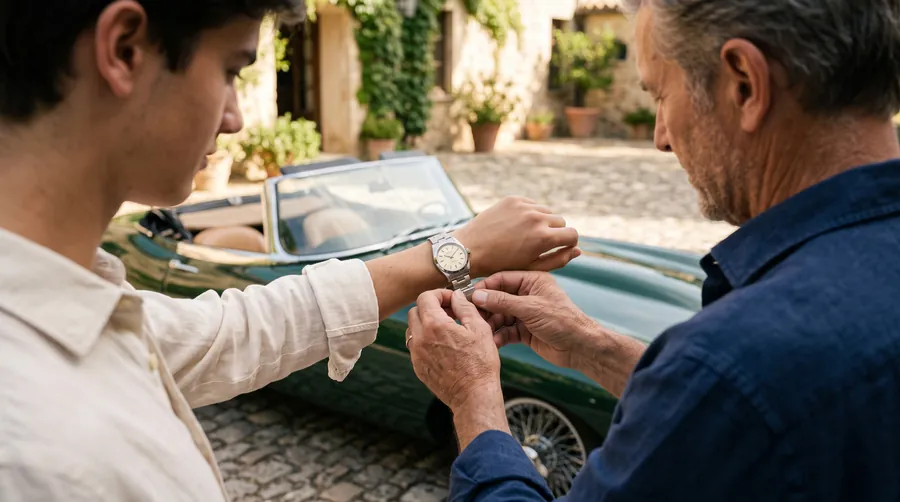
The first watch: at confirmation or sixteen, mechanical, simple
A first proper watch should be given when the child can look after it and will wear it, which for most children is somewhere between thirteen and sixteen, often tied to a confirmation, a bar or bat mitzvah or a big exam. It should be mechanical, because winding it every morning is the point, and it should be simple: a steel case, a plain dial, a good movement. The 3,000-euro classic from a serious house beats the 30,000-euro complication, which will be lost, scratched or resented. Many families pass on a parent's or a grandparent's watch instead, serviced and engraved on the back with the date, which is better still. The watch that gets worn for forty years is the one with a story, not the one with a price.
The first car: small, safe, second-hand, at eighteen
The first car is the rite that goes wrong most often, because it is the one where a parent's generosity is visible to every friend of the child. The rule that works is small, safe, second-hand and boring: a three-year-old hatchback with the best crash rating in its class, not a new sports car with a name. The reasons are not only financial. New drivers crash; a 20,000-euro car that is written off in the first year is a lesson, a 200,000-euro car that is written off is a catastrophe and, frequently, a lawsuit. Insurance for eighteen-year-olds on powerful cars is either unavailable or absurd. And a teenager who arrives at university in a supercar has told everyone who they are before they have opened their mouth.
Make the child contribute: the insurance, the fuel, a share of the price from the summer job. Add a driving course on a skid pan or a racetrack, which is the best safety equipment money can buy. And keep the good cars in the family for later, when the child has driven ten years without a claim.
The first credit card: a debit card at fourteen, a credit card at eighteen, limits on both
Money that is invisible is the hardest to understand. Children who grow up with a family account that pays for everything learn that a card is a key, not a wallet. The families who do this well give a prepaid or debit card at twelve to fourteen with the monthly allowance loaded onto it, and nothing else. The card runs out; the child learns. At sixteen, the card carries the clothes and travel budget. At eighteen, a credit card with a limit of one month's allowance and a rule: paid off in full every month or it goes.
The lesson is not thrift; the family can afford anything. The lesson is that money has edges, that a balance is a number that goes down, and that a card is a loan from your future self. A child who has run out of money on a Thursday at fifteen has learned more about finance than most business school graduates.
The pattern
All three rites work the same way: the object is modest relative to what the family could afford, the age is tied to a real step in the child's life, and the child has skin in the game, by winding the watch, paying the insurance, or paying off the card. Get the pattern right and the rites can be as generous as you like later: the good watch at thirty, the good car at forty. There is no hurry; the children will be rich for a long time.
For the watch and the other gifts at each stage, the Gift Finder filters by occasion and age.