Music is the passion that families of means fund most generously and lose most often. The instrument is bought, the teacher is hired, the child practises for a year, then the practice becomes a fight, then it stops, and the grand piano becomes a table for photographs. The pattern is so common that it is worth stating the alternative plainly: the children who play for life were taught as a habit, not as an achievement, and the habit was built by a parent as much as by a teacher.
Which instrument, when
Piano at five or six, because it teaches reading music, harmony and both hands at once, and because a child who can play the piano can learn anything else later. Or violin, cello or recorder at five for a child who asks; string instruments come in small sizes and the Suzuki method works for the very young. Guitar from seven. Wind and brass from eight or nine, when the lungs and the front teeth are ready. Drums from eight in a house with a separate wing. Singing, always, from the beginning, in a choir; the cathedral and school choirs are the best musical education money cannot buy, because they are free and selective.
The teacher
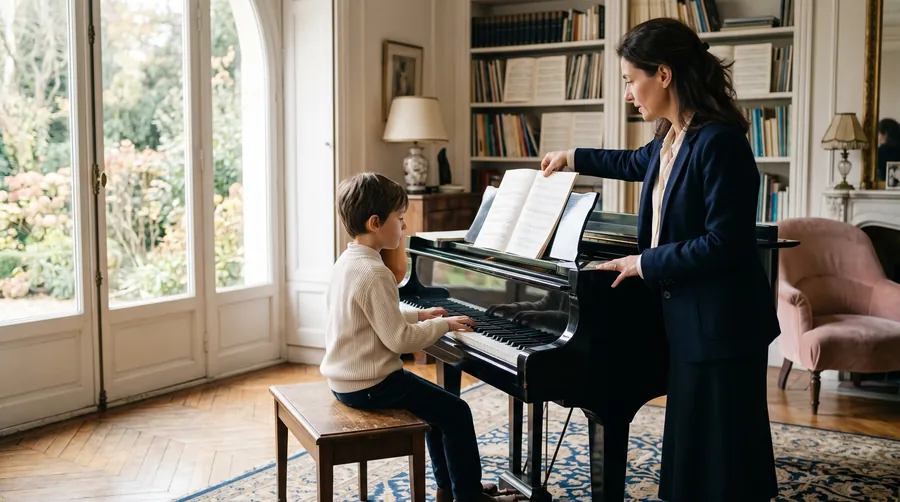
The teacher matters more than the instrument, the school or the parents' taste. A good children's teacher is patient, plays well, laughs, sets small goals, tells the child the truth kindly and tells the parents the truth plainly. Fees are 40 to 120 euros for a half-hour lesson in the cities of Europe; the conservatoire-trained specialist at 150 is for the child who is going somewhere, at twelve, not at six. The teacher comes to the house for young children if the family can arrange it; the child goes to the teacher from about ten, because the journey is part of the seriousness. Change the teacher if the child dreads the lesson for a term. Do not change the teacher because the child is not progressing; ask the teacher why.
The fifteen minutes
Practice is the whole question. A child under ten practises for fifteen minutes a day, every day, at the same time, with a parent in the room, not on the phone, for the first two years. Fifteen minutes daily beats an hour on Sunday by a distance, and the parent in the room is what turns practice from a chore into company. From ten, twenty to thirty minutes, alone, with the parent listening from the next room and saying something specific afterwards. From thirteen, whatever the child wants, because by then it is theirs or it is over.
The instrument at home
A good instrument, not a great one. An upright piano of quality, tuned twice a year, in a room the family uses, not a grand in a room the family does not. A violin rented in the right size and bought when the child stops growing. Instruments that sound good are practised; instruments that are too big, too cheap or in the wrong room are not. The Gift Finder lists the instruments by age.
The exams and the concerts
Graded examinations give structure and a certificate and suit children who like goals; they do not suit everyone and they are not the point. Concerts are: the school concert, the family Christmas, the grandparents' birthday, the piece played for guests after dinner. A child who has played for twenty people at eight is not afraid of a room at thirty. Our fifty experiences before eighteen has playing for guests at number twenty.
When to stop
When the child asks, twice, six months apart, seriously. Not the first time; every child asks the first time. A child who stops at fourteen after nine years of piano has a skill for life and will come back to it. A child who is made to continue for the parents' sake stops at eighteen and never opens the lid again. The instrument was for the child; the decision is too.