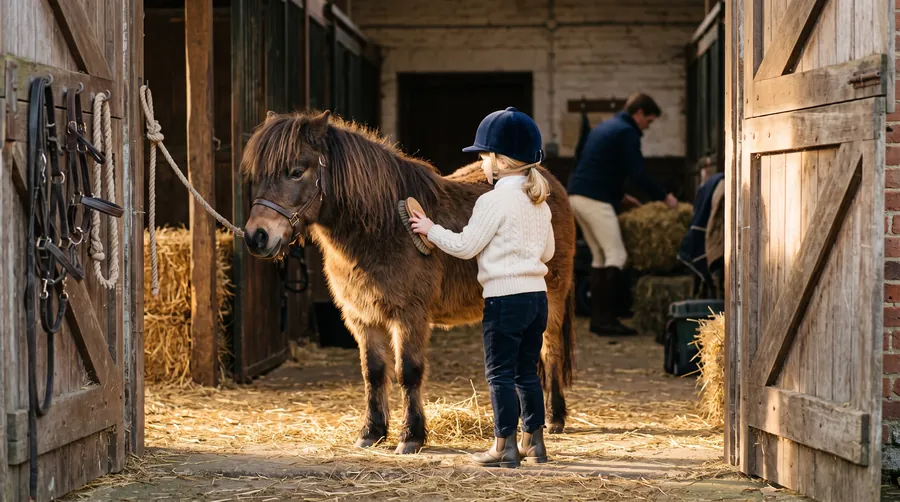

Every child who rides remembers the first pony, and every parent who bought one remembers the bill. Riding is the most expensive of the childhood passions after skiing and the most rewarding, because a pony is not a piece of equipment. It has to be fed on Christmas morning, it goes lame the week before the show, it bites, it loves, and it teaches a child who has staff at home that some things cannot be delegated.
When
Lessons from five, on a lead rein, at a good school with small ponies and patient instructors, once a week for a year. Then twice a week, off the lead, with the child learning to catch, groom, tack up and muck out as part of the lesson. A pony of the child's own after that year, at seven or eight, if three things are true: the child asks to go when it rains, the child does the grooming without being told, and somebody else can do the mucking out on school days.
Which
The first pony is small, old, kind and slightly boring. A twelve-hand veteran of twenty who has taught four children is worth more than a young pony with prospects, and costs less: 3,000 to 12,000 euros. The pony is chosen by an instructor who knows the child, tried three times, vetted by an independent vet, and bought or, better, loaned for a year with an option. The child's second pony, at ten or eleven, is where ambition enters: 10,000 to 40,000 euros for a competition pony, more for the ones with names. Families who buy the second pony first buy a frightened child.
What it costs
Livery at a good yard, with the pony fed, turned out, mucked out and exercised on school days: 800 to 1,800 euros a month in Germany, Switzerland and England, less in Spain. Farrier every six weeks, vet, dentist, worming, insurance, tack, rugs, the child's kit, lessons and competition fees: 500 to 1,200 euros a month on top. A lorry or a trailer and a car to pull it, if the child competes. Call it 15,000 to 35,000 euros a year for one pony at a good yard, before the second pony, which arrives sooner than anyone planned.
The yard
The yard matters more than the pony. A good yard has an instructor who teaches children, a school with a surface, safe hacking, other children of the same age and standard, a yard manager who notices when a pony is off, and a culture in which the child does the work. A yard where the groom does everything and the child arrives to ride produces a rider and not a horseman, and the difference shows at the first fall.
Safety
A hat to the current standard, replaced after any fall; a body protector for jumping and hacking; boots with a heel; gloves; a pony that is the right size and temperament; an instructor within sight until the child is competent; and a parent who understands that riding is the sport with the highest rate of serious injury in childhood, and that most of those injuries happen on the ground, leading, grooming, in the stable. The sports injuries article applies to riders more than to anyone.
The Pony Club and the competitions
The Pony Club and its equivalents in Germany, Switzerland and Spain are the best thing about children's riding: rallies, camps, tests, teams and other children. Competitions from eight or nine, small and local first, and the parent's job is the sandwiches, not the coaching. A child who competes because she wants to will tell you; a child who competes because the family does will tell you in a different way.
The end
Most children stop riding somewhere between fourteen and seventeen, when school, sport and social life crowd it out, and some come back at thirty. The pony goes on loan to the next family, which is the honourable end. The families who did it well have a child who can handle a large animal, get up at six, lose a class and shake hands, and remember the smell of a stable as the smell of being trusted. That is what 2,000 euros a month bought, and it was cheap.