
Sailing is the passion that families of means most often get backwards. They buy or charter the yacht first, the children sit on the deck with a crew doing the work, and at sixteen the children can mix a drink at anchor but cannot sail a boat across a bay. The children who become sailors learned in small boats, in cold water, in a course that treated them exactly like the child from the local club, and the yacht came later as a reward.
The age
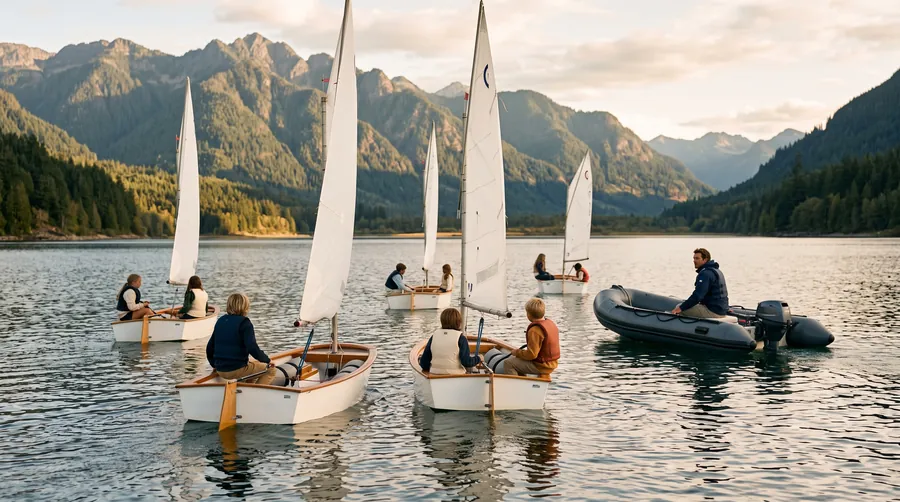
Water familiarisation and swimming from three; a child who sails must swim fifty metres in clothes. Dinghy sailing from eight, in an Optimist, the tiny pram-bowed boat in which every Olympic sailor started, on a lake or a sheltered bay, in a course of a week or a season. Double-handed boats from eleven or twelve, catamarans and windsurfing from twelve, keelboats and the first crewed passages from fourteen. The child who is still in an Optimist at thirteen is racing it.
The course
A week's course at a sailing school on a lake or a coast: the schools of Lake Geneva, Lake Constance and the Bavarian lakes, the Royal Yachting Association schools of the south coast of England and Scotland, the clubs of Mallorca, Sardinia and the Costa Brava, the Ionian flotilla bases for families. Five days, mornings on the water, a certificate at the end, other children. Ten children to two instructors, a safety boat, wetsuits and buoyancy aids provided. The cost is 300 to 900 euros a week, which is the best value in the whole of children's sport. Summer sailing camps, residential, for ten- to sixteen-year-olds, at 1,500 to 4,000 euros for two weeks, are where the passion becomes a skill.
The boat
An Optimist of the child's own, second-hand, 1,500 to 4,000 euros, once the first course is passed and the child asks. A club that will store it and a parent who will rig it on Saturdays. Racing from nine or ten if the child wants; the Optimist circuit is international, friendly and ferociously competitive, and produces children who can read wind on water like text. A double-hander, a Laser or an RS at twelve to fourteen, 5,000 to 15,000 euros. The keelboat and the yacht are the family's, not the child's, and the child crews them from twelve and skippers a small one at sixteen.
What sailing teaches
Physics, applied. Weather, read. Fear, managed: the capsize drill is the most important lesson of the first week and the child who has capsized and righted the boat alone is not afraid of the water again. Responsibility: a boat has to be rigged, checked, sailed and put away, and a rope left loose is a lesson tomorrow. Independence: a child alone in an Optimist a hundred metres from the shore is more alone than in any other sport, and it shows in the way they walk up the beach.
The family yacht
Once the children can sail, the yacht becomes a school rather than a sofa. Children of twelve stand watches, plot a course, handle the sails and take the helm in a harbour, under the skipper's eye. The two-week cruise around the Greek islands or the Balearics that the Family Trip Matcher suggests for families with sailing children is the reward for the Optimist years, and it is a different holiday when the children are crew.
The qualifications
The sailing schools issue certificates at every level, and the serious ones, the RYA's day skipper and yachtmaster or their national equivalents, are the gap-year qualifications of choice: a seventeen-year-old with a day skipper's certificate can charter a boat in the Mediterranean and a yachtmaster can be paid to skipper one. Our fifty experiences before eighteen has sailing a dinghy alone across a bay at number one, and it is number one for a reason.