
Manners are not about forks, and the families who understand this teach their children something more useful than which fork: the habit of noticing the other person. Table manners are simply the most visible version. A child who has them is asked back; a child who does not is talked about. And the training cannot be bought, which is why it is worth so much: it happens at the family table, every evening, for ten years.
Two to four: the table is where we eat
Children sit at the family table from the moment they can sit, in a high chair, with the adults, for the adults' meal, not a separate children's supper in front of a screen. They learn that food arrives when everyone is seated, that we wait, that we say thank you to whoever cooked, that we do not leave until we are excused. It is chaotic and it is the foundation.
Four to seven: cutlery, napkins, conversation
Knife and fork held properly, in the European or the American manner as the family prefers, but properly. Napkin on the lap. Mouth closed while chewing. Elbows off the table. Asking for the salt rather than reaching. And the beginning of conversation: a question to the person next to you, an answer longer than one word, waiting for a gap rather than interrupting. Parents model it by putting their own phones in another room.
Seven to ten: the formal dinner
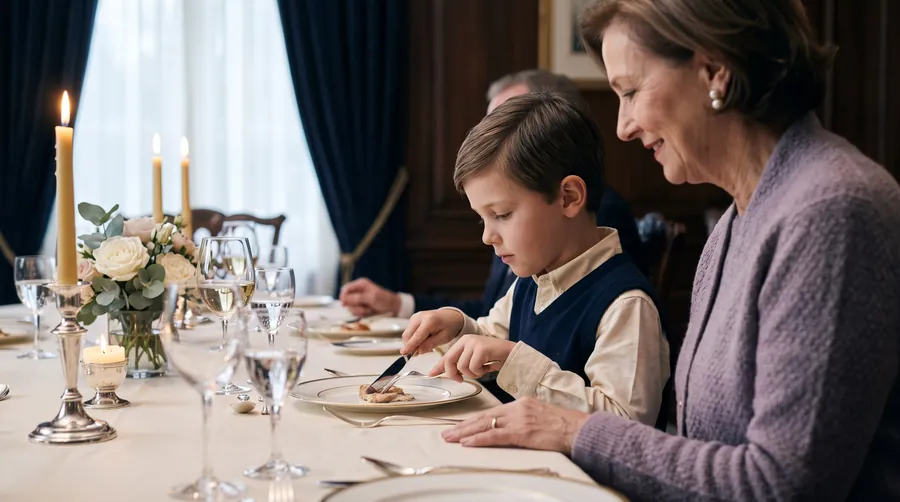
By eight, a child can be taken to a good restaurant and to a formal dinner at a grandparent's house: several courses, several glasses, place cards, a menu to read. This is the age for the finer points: which glass is water, how to break bread, what to do with the fish knife, how to signal that you have finished, how to leave the table quietly, how to thank the host. And the age for conversation as a skill: three questions ready for the adult on either side, a story of their own to tell if asked, and the understanding that being bored is not an excuse for showing it.
Ten to twelve: hosting
The child who has learned to be a guest now learns to be a host: laying the table, seating a plan, greeting guests at the door, offering drinks, making sure the shy cousin is talked to, thanking everyone as they leave. Birthday parties are the training ground; see the party without the circus. By twelve, the child can carry a dinner.
The rules that matter more than the rules
- Eyes up. Look at the person who is talking to you. Look at the waiter when you order and say please and thank you.
- Nobody eats until everyone is served, and the host starts.
- The staff are people. Children who grow up with a cook and a housekeeper thank them by name, every meal.
- Complaining about food is done in private, later, to a parent, never at the table.
- Phones do not exist at the table, for anyone, including the parents, including at restaurants, including at breakfast.
Why it matters more for wealthy children
Because they are watched. The child of a prominent family who is rude to a waiter is a story by the evening. The child who is charming to the waiter is also a story, and a better one. And because the world these children will move in, the boarding school dining hall, the university formal, the client dinner, the board lunch, runs on the assumption that they know. A child who does not know is not corrected. They are simply not asked again.